If you have ever listened to a piece of music and felt like it had a slow, sweeping, almost majestic pulse, you may have been hearing the 6/4 time signature at work. It is one of the more nuanced meters in music, and yet it shows up in everything from orchestral masterpieces to popular songs.
Whether you are a beginner trying to make sense of music notation or an experienced musician looking to sharpen your understanding, this guide covers everything you need to know. You will learn the 6/4 time signature meaning, how to count it, how it compares to 6/8, how to conduct it, and much more.
1. 6/4 Time Signature Meaning
What Do the Numbers Mean?
A time signature sits at the beginning of a piece of sheet music and tells you two things:
- The top number tells you how many beats are in each measure.
- The bottom number tells you what kind of note gets one beat.
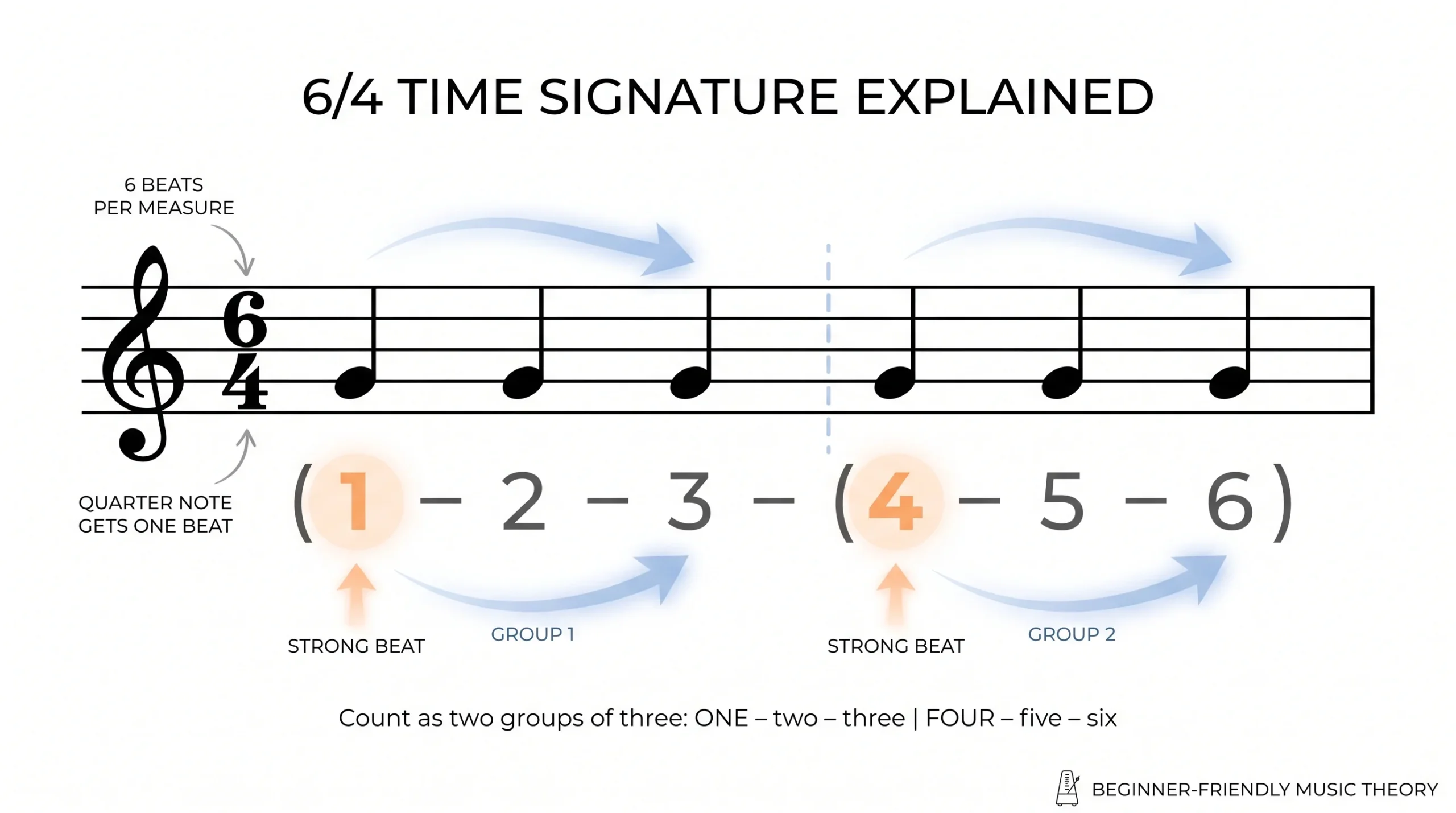
In the 6/4 time signature:
- 6 = there are 6 beats per measure.
- 4 = the quarter note gets one beat.
So every measure contains six quarter notes or any combination of notes and rests that add up to six quarter-note values.
Why Does 6/4 Matter?
The 6/4 meter creates a unique rhythmic feel that is broader and more expansive than most other time signatures. Unlike 4/4 (common time), which has a steady four-beat march, or 3/4 (waltz time), which has a light three-beat lilt, 6/4 carries a sense of grandeur and forward momentum.
Composers often choose 6/4 when they want music to feel sweeping, noble, or emotionally weighty.
2. How to Count 6/4 Time Signature
Step-by-Step Counting Guide
Counting in 6/4 is straightforward once you know the pattern. Here is how to do it:
Step 1: Count to six
Every measure gets six beats. Count them out loud:
1 – 2 – 3 – 4 – 5 – 6 | 1 – 2 – 3 – 4 – 5 – 6
Step 2: Feel the two natural groups
The six beats naturally divide into two groups of three:
(1 – 2 – 3) – (4 – 5 – 6)
Beat 1 carries the primary accent (strongest beat). Beat 4 carries the secondary accent (slightly weaker, but still important).
Step 3: Emphasize beats 1 and 4
As you count, give a slight stress to beats 1 and 4:
ONE – 2 – 3 – FOUR – 5 – 6
Step 4: Try it with clapping
- Clap loudly on beats 1 and 4.
- Clap softly on beats 2, 3, 5, and 6.
This immediately gives you the characteristic two-in-a-bar feel that defines 6/4.
Note Values in 6/4
| Note | Beats It Gets |
|---|---|
| Quarter note | 1 beat |
| Half note | 2 beats |
| Dotted half note | 3 beats |
| Whole note | 4 beats |
| Dotted whole note | 6 beats (full measure) |
3. Is 6/4 Time Signature Simple or Compound?
This question trips up a lot of learners, and the answer depends on how you approach the meter.
The Short Answer
6/4 is a compound duple time signature.
Here is why:
- Compound means each beat subdivides into three equal parts rather than two. In 6/4, each group of three quarter notes (beats 1-2-3 and 4-5-6) functions as one compound beat that divides into triplet subdivisions.
- Duple means there are two main beats per measure (the two groups of three).
Simple vs. Compound A Quick Comparison
| Feature | Simple Meter | Compound Meter |
|---|---|---|
| Beat division | Divides into 2 | Divides into 3 |
| Feel | Even, straight | Rolling, lilting |
| Examples | 2/4, 3/4, 4/4 | 6/8, 9/8, 12/8, 6/4 |
When you feel 6/4 as “two big beats per bar,” each of those beats has a natural three-part subdivision — which is exactly what makes compound meters sound so fluid and flowing.
4. 6/4 Time Signature vs 6/8: What Is the Difference?
The 6/4 vs 6/8 comparison is one of the most common sources of confusion in music theory. Both have six beats with a two-in-a-bar feel, so what actually sets them apart?
The Core Difference: Note Values
| Feature | 6/4 | 6/8 |
|---|---|---|
| Beats per measure | 6 | 6 |
| Beat unit | Quarter note (♩) | Eighth note (♪) |
| Main pulse | 2 dotted half notes | 2 dotted quarter notes |
| Typical tempo | Slower, broader | Faster, more lilting |
| Feel | Grand, majestic, weighty | Lively, dance-like, flowing |
Think of It This Way
- In 6/8, the beat is an eighth note, so a measure is two groups of three eighth notes. This creates a quick, bouncing feel, think of a jig or a shanty.
- In 6/4, the beat is a quarter note, so a measure is two groups of three quarter notes. This creates a slower, more spacious feel, think of a hymn or a film score.
A Practical 6/4 Time Signature Example vs 6/8
Imagine counting to six while walking:
- 6/8 feel: Your steps are quick and light ta-ta-ta / ta-ta-ta
- 6/4 feel: Your steps are slow and deliberate ONE – two – three / FOUR – five – six
Both are technically compound duple, but the quarter-note pulse in 6/4 gives it a noticeably broader, more stately character.
When Do Composers Choose 6/4 Over 6/8?
Composers choose 6/4 when they want:
- A slow, majestic flow in an orchestral or choral context
- More rhythmic space for long melodic phrases
- A sense of grandeur in hymns, anthems, or epic film music
They choose 6/8 when they want:
- A lively, dance-like energy
- A faster, skipping, or lilting feel
- The compact bounce is typical of folk music or sea shanties
5. 6/4 Time Signature Examples in Music
What Does a 6/4 Measure Look Like?
A single measure in 6/4 can be filled in many ways, as long as the note values total six quarter-note beats:
Example 1 All quarter notes:
♩ ♩ ♩ ♩ ♩ ♩ (6 beats)
Example 2 Two dotted half notes:
𝅗𝅥. 𝅗𝅥. (3 + 3 = 6 beats)
Example 3 Mixed values:
♩ ♩ ♩ 𝅗𝅥. (1 + 1 + 1 + 3 = 6 beats)
Example 4 Half notes and quarter notes:
𝅗𝅥 𝅗𝅥 ♩ ♩ (2 + 2 + 1 + 1 = 6 beats)
The Emotional Character of 6/4
Because the beat unit is a slower quarter note, melodies written in 6/4 tend to:
- Move in long, arching phrases
- Feel ceremonial or solemn
- Sounds expansive in orchestral settings
You will find 6/4 especially common in film scores, hymns, anthems, and Romantic-era orchestral music.
6. Popular 6/4 Time Signature Songs
One of the best ways to internalize the 6/4 feel is to listen to real 6/4 time signature songs. Here are some well-known examples across different genres:
Classical and Orchestral
- “Jupiter” from The Planets Suite : Gustav Holst
The famous, noble main theme is written in 6/4, giving it its iconic, broad sweep. - Symphony No. 6 (Pastoral) : Ludwig van Beethoven
Several movements use 6/4 to evoke the leisurely, open feeling of the countryside. - “Nimrod” from Enigma Variations : Edward Elgar
A deeply expressive piece in 6/4 that carries great emotional weight.
Hymns and Sacred Music
- “Be Thou My Vision” : Traditional Irish Hymn
This beloved hymn flows naturally in 6/4, giving it its timeless, meditative quality. - “Morning Has Broken” : Eleanor Farjeon / Cat Stevens
The gentle, rolling feel of this song comes directly from its 6/4 time.
Film and Contemporary Music
- “The Lord of the Rings” themes : Howard Shore
Several cues from the trilogy use 6/4 to create an epic, mythological atmosphere. - “Hallelujah” : Leonard Cohen
Though often performed in 6/8, some arrangements and covers shift to 6/4 for a fuller, broader feel.
Listening actively to these pieces while counting 1-2-3 / 4-5-6 will help you lock in the 6/4 groove faster than any exercise.
7. 6/4 Time Signature Conducting
How Do Conductors Beat 6/4?
6/4 time signature conducting is a skill that varies depending on the tempo. Conductors have two main options:
Option A: The Six-Beat Pattern (Slow Tempo)
When the tempo is slow, conductors beat all six quarter notes individually. The standard six-beat conducting pattern looks like this:
- Beat 1 → Down (the primary downbeat)
- Beat 2 → Slightly inward
- Beat 3 → Out to the left
- Beat 4 → Slightly up and to the right (the secondary accent)
- Beat 5 → Out to the right
- Beat 6 → Up (rebounds to prepare for beat 1)
This pattern gives each musician a clear visual cue for every beat.
Option B: The Two-Beat Pattern (Fast Tempo)
When the tempo is fast, beating all six beats becomes impractical. In this case, conductors use a two-beat (duple) pattern, treating each group of three quarter notes as one large beat:
- Beat 1 → Down (covering beats 1-2-3)
- Beat 2 → Up (covering beats 4-5-6)
Tips for Conductors
- Always give a clear preparatory beat before the downbeat so musicians know the tempo.
- Use a full, broad arm movement in 6/4; the sweeping quality of the music should be reflected in your gesture.
- The wrist rebound after beat 1 should be softer than the main downbeat to show the difference between the primary and secondary accents.
- When shifting between six-beat and two-beat patterns mid-piece (due to tempo changes), signal the switch clearly to the ensemble.
8. Using a Metronome with 6/4 Time Signature
A 6/4 time signature metronome setting is one of the most practical tools you can use to internalize this meter. Here is how to use it effectively.
Setting Your Metronome for 6/4
Option 1: Count every beat
Set the metronome to click on every quarter note. Each click equals one beat, so you count:
Click – Click – Click – Click – Click – Click (1 – 2 – 3 – 4 – 5 – 6)
This works well at slow to moderate tempos.
Option 2: Feel the two main pulses
Set the metronome to a slower tempo and let each click represent a dotted half note (three quarter notes). Now each click is one big compound beat:
Click (1-2-3) – Click (4-5-6)
This approach helps you feel the two-in-a-bar character of 6/4.
Recommended Practice Tempos
| Level | Metronome Setting (quarter note = BPM) |
|---|---|
| Beginner | ♩ = 60–72 |
| Intermediate | ♩ = 80–100 |
| Advanced | ♩ = 108–132+ |
Practice Routine with Metronome
- Set the metronome at ♩ = 60.
- Clap on beats 1 and 4 while counting all six beats out loud.
- Play a scale (or simple melody) with one note per beat.
- Increase tempo by 5 BPM once the pattern feels comfortable.
- Record yourself occasionally to check if your accents on 1 and 4 are consistent.
Many modern metronome apps (such as Pro Metronome or Soundbrenner) allow you to set the time signature directly to 6/4, which automatically accents beats 1 and 4, a huge help for beginners. If you are a student looking for AI-powered study tools that can support your music learning journey, tools like AI homework helpers have become surprisingly capable.
Conclusion
The 6/4 time signature is a powerful and expressive meter that gives music a sweeping, majestic quality unlike any other. Here is a quick recap of everything covered in this guide:
- Meaning: 6 quarter-note beats per measure, naturally grouped as 2 × 3.
- Counting: Accent beats 1 and 4 ONE-2-3-FOUR-5-6.
- Classification: Compound duple meter (each main beat divides into three).
- vs 6/8: 6/4 uses a slower quarter-note pulse, making it broader; 6/8 uses a faster eighth-note pulse, making it more lilting.
- Songs: Found in hymns, film scores, Romantic orchestral music, and more.
- Conducting: Use a six-beat pattern at slow tempos, a two-beat pattern at fast tempos.
- Metronome: Practice by clicking on every quarter note or every dotted half note.
Once you start recognizing the 6/4 feel, you will hear it everywhere in church, at the cinema, in concert halls, and on the radio. Take your time with it, practice with a metronome, and listen to the songs listed above. The 6/4 time signature will quickly move from confusing concept to trusted musical tool.
As AI tools continue to reshape how students learn complex subjects from mathematics to music theory, exploring what AI-assisted education has to offer is well worth your time.