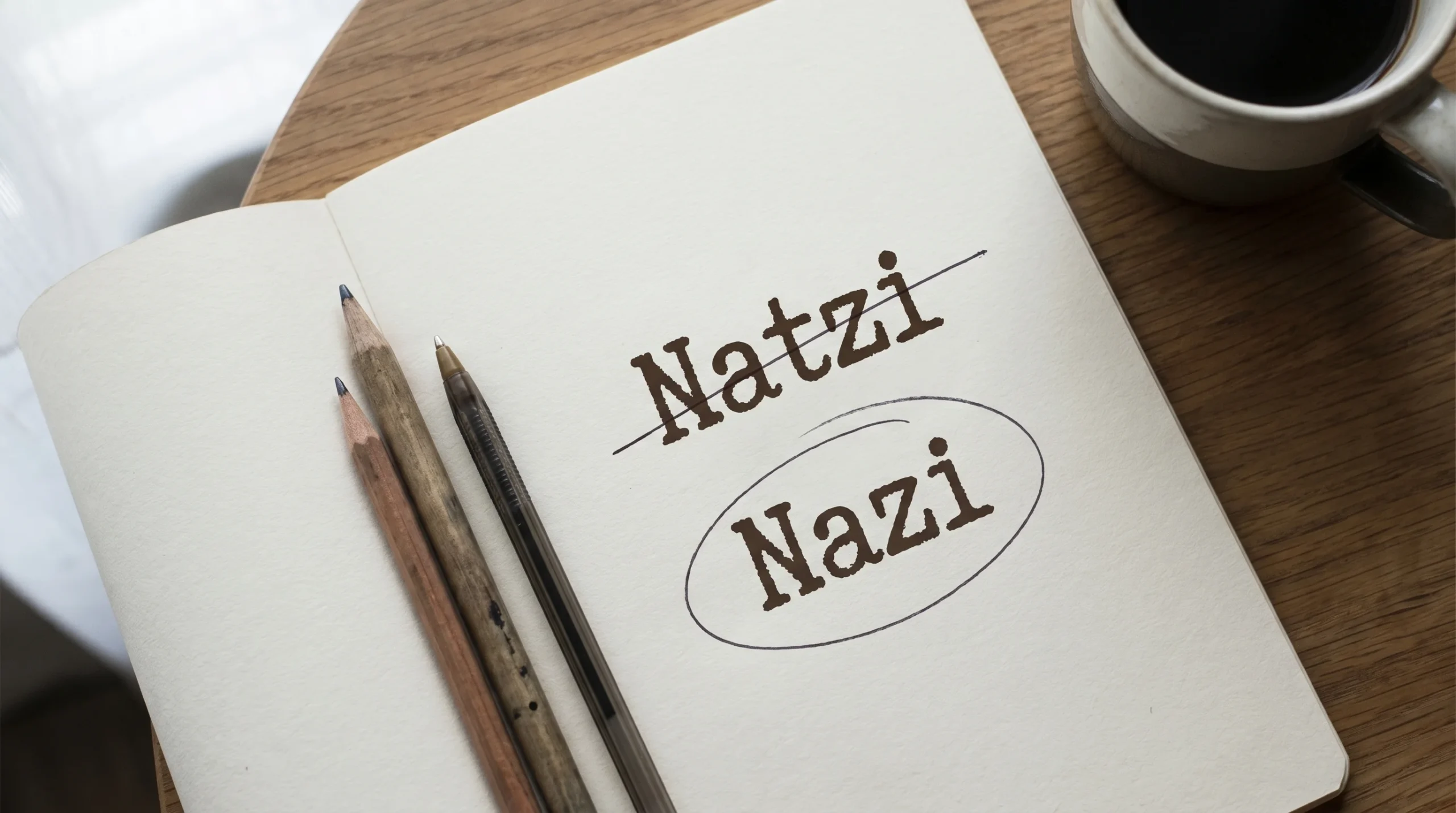
The correct spelling is “Nazi,” not “Natzi.” “Natzi” is a misspelling that appears frequently in online searches, but it has no historical, linguistic, or grammatical basis. If you have ever typed “natzi” by mistake, you are not alone, but the right form is always “Nazi.”
This article covers everything you need to know: why the misspelling happens, how to pronounce it correctly, what the word means, its plural form, key symbols, the Nazi soldier, a brief look at Nazi Germany, and how the word lives on in modern language.
Natzi vs. Nazi: Which Spelling Is Correct?
The word comes from the German abbreviation of Nationalsozialismus (National Socialism). In German, the letters “Na-zi” are drawn directly from the first syllables of Natio-nal-so-zi-alist. There is no “t” anywhere in that source word, which is exactly why “Natzi” is wrong.
Here is a quick side-by-side comparison:
| Spelling | Correct? | Reason |
|---|---|---|
| Nazi | Yes | Derived from Nationalsozialist |
| Natzi | No | Misspelling with no etymological basis |
| Nazie | No | Incorrect English adaptation |
| Nazy | No | Phonetic guess, not an accepted form |
Always use Nazi in writing, regardless of whether you are referring to the historical movement, using it in an academic context, or using it colloquially (such as “grammar Nazi”).
Why Do People Write “Natzi” Instead of “Nazi”?
This is one of the most interesting spelling questions in English, and it has several real explanations.
Phonetic Confusion
When people hear the word spoken out loud, they often try to spell it the way it sounds to them. In some English accents, the “z” in “Nazi” can sound slightly like a “tz” combination, leading to the “Natzi” misspelling.
Influence of Similar Words
English has many words where a “t” precedes a “z” think “pretzel,” “ritz,” or “blitz.” The brain subconsciously borrows patterns from familiar words and inserts a “t” where it does not belong.
Unfamiliarity With German Abbreviation Rules
Most English speakers do not know that “Nazi” is a clipped abbreviation from a long German compound word. Without that context, the spelling feels arbitrary and becomes easier to get wrong.
Autocorrect and Typing Speed
On mobile devices, autocorrect sometimes changes ‘Nazi’ to alternate forms, and fast typists frequently insert extra letters by accident. This is one reason AI-powered writing and homework tools are increasingly being used to check spelling and explain word origins in real time
The Word’s Sensitivity
Because the word carries heavy historical weight, many people feel uncomfortable writing it or looking it up, which means they have less exposure to its correct form and are more likely to guess the spelling.
Is It Pronounced “Natzi” or “Nazi”? A Clear Phonetic Guide
This is a very common question, and the answer is straightforward.
The correct pronunciation is: NAHT-see
- The “Na” sounds like the “na” in “father” an open “ah” vowel, not the “a” in “cat.”
- The “zi” sounds like “see” a soft “s” sound, not a hard “z.”
- There is no “t” sound in the pronunciation. You do not say “nat-zee” or “nat-see.”
| Version | Phonetic Spelling | Correct? |
|---|---|---|
| Nazi | NAHT-see | Yes |
| Natzi | NAT-zee | No |
The confusion between “natzi” and “nazi” in pronunciation largely comes from speakers who unconsciously add a “t” before “z,” a habit borrowed from English words like “pretzel” (PRET-zel). In “Nazi,” that “t” simply does not exist.
What Is the Plural Form of Nazi?
The plural of Nazi is Nazis. Simply add an “s” at the end.
- One Nazi soldier
- Several Nazi soldiers → Several Nazis
- A group of Nazis
There is no apostrophe in the plural form. Writing “Nazi’s” to mean more than one is a grammatical error (an apostrophe here would indicate possession, not plurality).
Correct: The Nazis rose to power in 1933.
Incorrect: The Nazi’s rose to power in 1933.
The adjective form is also “Nazi” (no change): “a Nazi regime,” “Nazi propaganda,” “Nazi ideology.”
What Does “Nazi” Mean? A Simple Historical Explanation
“Nazi” refers to a member or supporter of the National Socialist German Workers’ Party (Nationalsozialistische Deutsche Arbeiterpartei, or NSDAP), the far-right political party that ruled Germany from 1933 to 1945 under Adolf Hitler.
Key points about the historical meaning:
- Ideology: Nazism combined extreme nationalism, racism (particularly antisemitism), totalitarianism, and militarism.
- Rise to power: The Nazi Party gained control of Germany in January 1933 when Hitler was appointed Chancellor.
- World War II: Nazi Germany’s expansionist aggression directly triggered World War II in Europe in 1939.
- The Holocaust: The Nazi regime systematically murdered six million Jews, along with millions of others, including Roma, disabled people, political opponents, and LGBTQ+ individuals.
- Fall: Nazi Germany collapsed in May 1945 with Germany’s unconditional surrender to the Allied forces.
The word “Nazi” today carries deep moral weight. It is used in historical, educational, and journalistic contexts to describe this specific ideology and its followers.
Nazi Symbols: The Nazi Cross and Other Key Symbols
Several symbols became associated with Nazi Germany. Understanding them helps in historical study and in recognizing their misuse today.
The Swastika (The “Nazi Cross”)
The symbol most people call the “Nazi cross” is technically a swastika (from the Sanskrit svastika).
- The swastika is an ancient symbol used for thousands of years across Hindu, Buddhist, and other cultures as a sign of good fortune.
- The Nazis adopted and rotated it 45 degrees, turning it into a symbol of their regime.
- In Nazi use, it appeared on the party flag, armbands, buildings, and military insignia.
- Today, the swastika is banned in Germany and several other countries when displayed in a Nazi context.
- It is important to distinguish the Nazi swastika from its pre-existing use in other cultures, where it retains its original, peaceful meaning.
Other Nazi Symbols
- SS Bolts: The double lightning bolt symbol of the Schutzstaffel (SS), the Nazi paramilitary organization.
- Iron Cross: A traditional German military decoration that predates the Nazis but was used during the Nazi era.
- Nazi salute: The raised right arm, known as the Hitlergruß (Hitler salute), was used as a mandatory greeting in Nazi Germany.
Many of these symbols remain banned or heavily restricted in several countries due to their association with hate and genocide.
Nazi Soldiers and Nazi Germany: A Brief Overview
Nazi Soldiers
A Nazi soldier most commonly refers to members of the Wehrmacht (the regular German armed forces) or the SS (Schutzstaffel), the elite paramilitary and police force of the Nazi Party.
- Wehrmacht soldiers fought in conventional military operations across Europe, North Africa, and the Soviet Union.
- The SS was responsible for running concentration camps and carrying out mass killings during the Holocaust.
- Not all German soldiers during World War II were Nazi Party members, but they served under Nazi command and fought for the Nazi state.
Nazi Germany Map
Nazi Germany’s territory changed dramatically between 1933 and 1945:
- 1933: Germany within its post-WWI borders (the Weimar Republic territory).
- 1936–1938: Germany reoccupied the Rhineland and annexed Austria (Anschluss) and the Sudetenland.
- 1939–1942: At its peak, Nazi-controlled territory stretched from France in the west to deep into the Soviet Union in the east, and from Norway in the north to North Africa in the south.
- 1943–1945: Allied forces progressively reclaimed territory until Germany’s total defeat in May 1945.
Understanding the Nazi Germany map is essential for grasping the scale of the regime’s military campaigns and the geographic scope of the Holocaust.
“Nazi” in Modern Language: The Grammar Nazi and Other Informal Uses
Outside of its historical meaning, “Nazi” has entered informal English as a strong intensifier meaning someone who enforces rules with extreme strictness or rigidity.
Grammar Nazi
A grammar Nazi is someone who aggressively corrects other people’s spelling, grammar, or punctuation, often in casual or online settings where such corrections are unwelcome.
- Example: “He corrected my text message punctuation. What a grammar Nazi.”
- The term is informal and generally used with light humor, though some people find it offensive because of the word’s historical weight.
- Other similar uses include “food Nazi,” “sleep Nazi,” or “parking Nazi,” all describing someone who enforces a particular rule with excessive strictness.
Should You Use It?
This informal usage is widely understood but remains controversial. Many people feel the word is too historically loaded to be used casually. In professional or formal writing, it is better to use alternatives like “stickler” or “pedant” instead.
Nazi in Media: A Look at Nazi Movies
Films about Nazi Germany have played a major role in educating the public about this period of history. Several are considered important cinematic and historical works.
Notable examples include:
- Schindler’s List (1993) : Steven Spielberg’s landmark film depicting a German industrialist who saves over a thousand Jewish lives during the Holocaust.
- The Pianist (2002) : Roman Polanski’s film about a Jewish pianist surviving the Warsaw Ghetto under Nazi occupation.
- Downfall (2004) : A German film depicting Hitler’s final days in Berlin.
- Jojo Rabbit (2019) : A satirical film seen through the eyes of a young boy in Nazi Germany.
- The Boy in the Striped Pyjamas (2008) : A drama exploring the Holocaust through the friendship of two boys on either side of a concentration camp fence.
These Nazi movies serve an important educational purpose. They keep history alive, confront viewers with the consequences of hatred and extremism, and ensure that the events of the Holocaust are never forgotten.
Frequently Asked Questions (FAQ)
1. Is “Natzi” ever an acceptable spelling?
No. “Natzi” is always a misspelling. There is no context, historical, academic, or informal, in which “Natzi” is the correct form. Always write “Nazi.”
2. Where does the word “Nazi” come from?
It is a German abbreviation. “Na” comes from National and “zi” from Sozialist in the full party name Nationalsozialistische Deutsche Arbeiterpartei (NSDAP). The abbreviation was in common use in Germany well before the party rose to power.
3. How do you correctly pronounce “Nazi”?
Pronounce it NAHT-see. The “a” is a broad “ah” sound, and the “zi” is a soft “see” sound. There is no “t” sound in the middle.
4. What is the plural of “Nazi”?
The plural is Nazis (no apostrophe). Example: “The Nazis controlled Germany from 1933 to 1945.”
5. Why is the swastika called the “Nazi cross”?
The swastika became so strongly associated with the Nazi regime that many people now refer to it as the Nazi cross. However, the swastika is an ancient symbol predating the Nazis by thousands of years. In non-Nazi contexts, it holds peaceful meaning in Hindu, Buddhist, and Jain traditions.
6. Is using the word “Nazi” to mean “a strict rule enforcer” offensive?
Opinions vary. Many people use it casually (e.g., “grammar Nazi”), but others find it disrespectful given the historical atrocities committed by the actual Nazi regime. In formal writing, alternatives like “stickler” or “pedant” are safer choices.
7. Was every German soldier in WWII a Nazi?
No. The Wehrmacht (regular German military) included many soldiers who were not members of the Nazi Party. However, they fought under and for the Nazi state. The SS, by contrast, was directly tied to the Nazi Party and carried out its most extreme crimes.
Conclusion
The answer is simple: Nazi is correct, and Natzi is a misspelling with no valid basis in language or history. The confusion happens because of phonetic guessing, unfamiliarity with the word’s German origins, and the influence of similar-sounding English words.
Here are the key points to remember:
- Correct spelling: Nazi
- Incorrect spelling: Natzi
- Correct pronunciation: NAHT-see (no “t” sound)
- Plural form: Nazis
- Origin: Abbreviated from Nationalsozialist in German
- Nazi cross: Refers to the swastika, an ancient symbol misappropriated by the Nazi regime
- Modern use: “Grammar Nazi” means a strict enforcer of rules, informal and sometimes controversial
- Nazi movies: Serve as important historical and educational works
Understanding the correct spelling, pronunciation, and meaning of ‘Nazi’ matters both for accurate communication and for respectfully engaging with one of the most significant and tragic chapters in modern history. If you are a student looking to strengthen your research and writing skills, exploring AI study tools designed for academic accuracy can help.