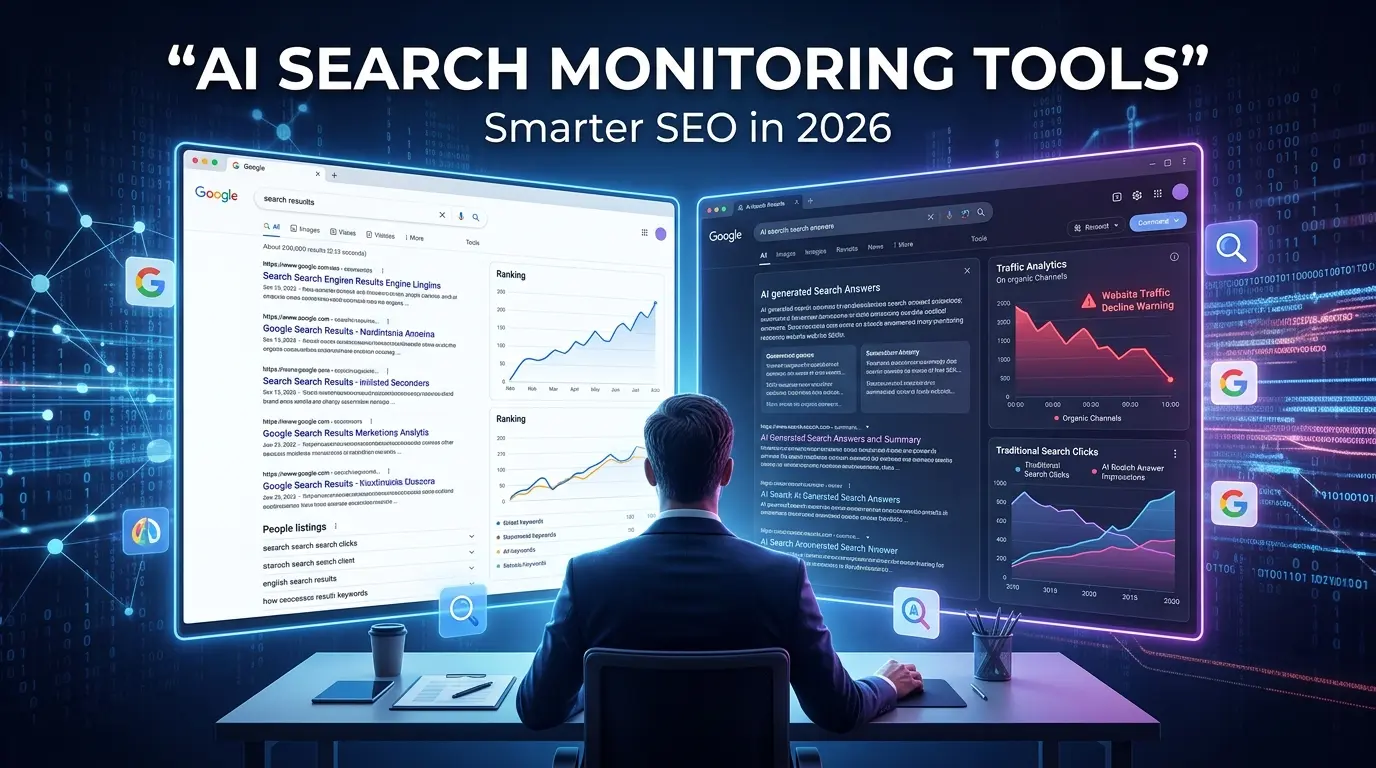
Search has changed faster in the last two years than in the previous decade. And if you’re still relying only on traditional SEO tools, you might be missing a huge piece of the picture. Here’s the hard truth: you could be ranking #1 on Google and still be invisible.
That’s because AI now summarizes search results directly on the page. Users get their answers without ever clicking through to your website. So even a top-ranking page can lose traffic silently, and without warning. This is exactly why AI search monitoring tools have become a must-have for serious SEO in 2026.
In this guide, you’ll learn what these tools do, why they matter, which metrics to track, and how to choose the right platform for your needs.
How Search Has Changed And Why It Matters
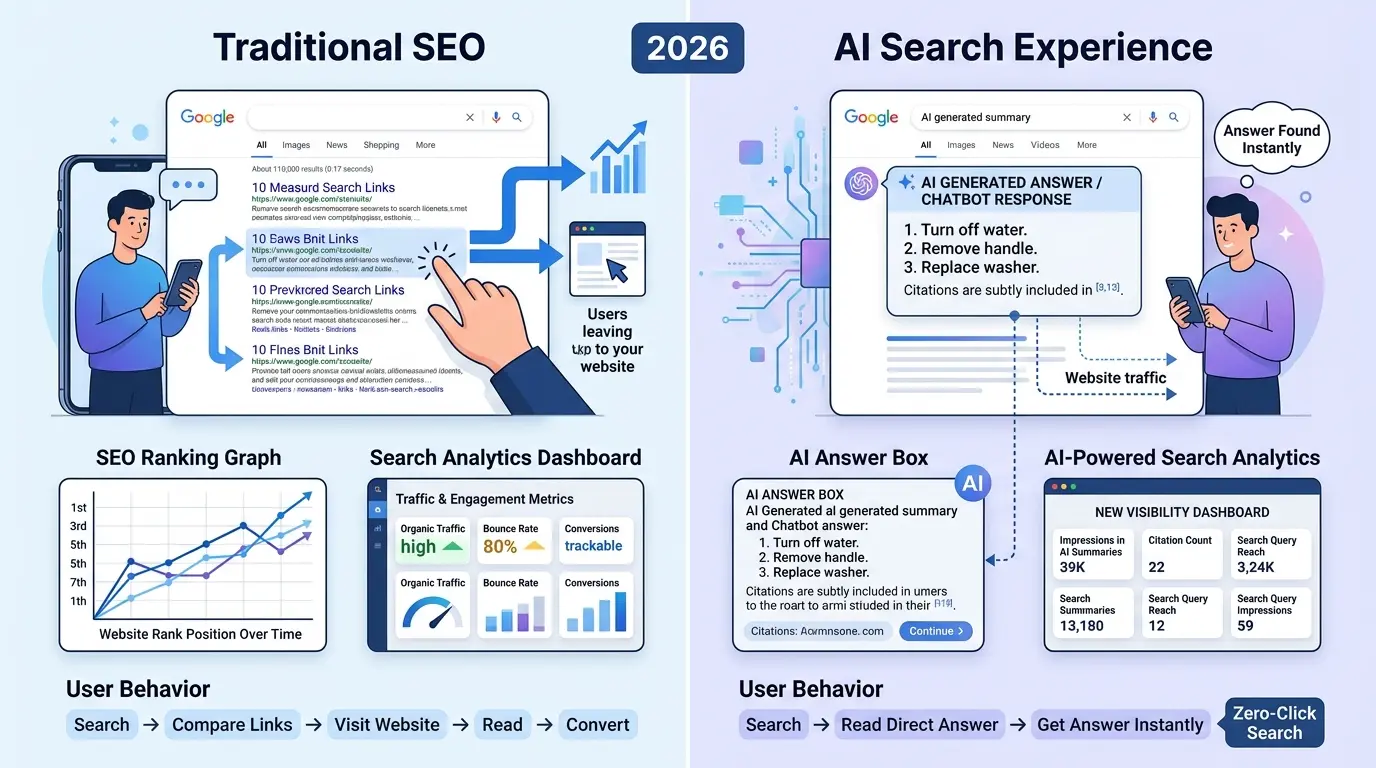
Search engines used to work simply. You typed a query, Google showed ten blue links, and you clicked one. Rankings were everything. That’s no longer how it works.
Google’s AI Overviews, along with other AI-powered search features, now read multiple pages and generate a single summarized answer at the top of the results page. Users see the answer immediately, no clicking required.
This shift has increased zero-click searches, where users get answers without visiting websites. Another brand with a lower ranking might get cited constantly inside AI answers. The gap between traditional rankings and AI visibility is real, and it’s growing.
The question marketers now need to ask isn’t just “Where do I rank?” It’s “Is AI mentioning me at all?”
What Are AI Search Monitoring Tools?
AI search monitoring tools are platforms that track how and how often your brand appears inside AI-generated search results.
Traditional SEO software tracks your keyword positions, backlinks, and traffic, but AI monitoring tools go deeper by tracking how your brand appears in AI search results.
These tools measure your visibility inside AI summaries, conversational search outputs, Google AI Overviews, and AI-enhanced search results pages. They also track competitor AI citations so you can see who’s winning the AI visibility game and why.
Think of them as your eyes inside a search experience you can’t see with a standard rank tracker.
Why AI Monitoring Is So Important for SEO Right Now
AI Results Are Reducing Website Clicks
When AI gives users a complete answer on the search results page, many people never visit any website. This is called zero-click search, and it’s becoming more common across all types of queries, especially informational ones.
If your brand isn’t cited inside those AI answers, you’re losing brand impressions, traffic opportunities, and authority even when you’re technically ranking. Traditional SEO tools won’t alert you to this. AI monitoring tools will.
AI Doesn’t Always Pick the #1 Ranking Page
This is one of the most misunderstood things about AI-driven search. Google’s AI doesn’t automatically pull from the top-ranked page. It selects sources based on content structure, clarity, topic depth, and domain authority.
A competitor with a lower organic ranking but better-structured, more authoritative content might appear inside AI summaries while your #1 page gets skipped entirely. Without monitoring, you’d never know it was happening. The question marketers now need to ask isn’t just “Where do I rank?” It’s Is AI mentioning me at all.
Competitor Shifts Happen Without Warning
AI visibility changes quietly. One week your brand dominates AI answers, the next week a competitor gets cited instead and your traffic drops. Without an AI monitoring tool tracking these changes over time, you’re left guessing at the cause.
AI search monitoring keeps you ahead of these shifts instead of chasing them after the damage is done.
Why You Should Use AI Search Monitoring Tools
Using these tools isn’t just about tracking a new metric. It changes how you approach your entire SEO strategy.
When you can see which queries trigger AI answers, you can create content specifically designed to be cited in those answers. When you can see which competitors are dominating AI summaries, you can analyze what they’re doing differently and close the gap. When you can track your AI citation rate over time, you can measure whether your optimizations are actually working.
Here are the core reasons marketers are adding these tools to their SEO stack:
- Track AI visibility separately from rankings: because they don’t always move together
- Discover content gaps: that exist in AI summaries but not in traditional search results
- Monitor Google AI Overviews: to see when your brand gets included or dropped
- Identify competitor citation dominance: so you can adjust your strategy
- Measure growth over time: with metrics that traditional tools don’t capture
Key Metrics to Track in AI Search Optimization
Once you start using an AI search monitoring platform, knowing which numbers to focus on makes all the difference.
AI Visibility Share
tells you how often your brand appears in AI-generated answers for your target keywords. This is your primary benchmark for AI SEO performance.
Citation Frequency
Measures how regularly AI systems reference your domain as a source. A high citation frequency means AI considers your content authoritative and trustworthy.
Organic vs. AI Position Gap
Compares where you rank traditionally versus how often you appear in AI answers. A large gap here signals that your content isn’t structured the way AI prefers even if it ranks well.
Competitor AI Share
Shows you which competing brands are being cited most often. This helps you understand the competitive landscape beyond traditional rank comparisons.
Visibility Trends Over Time
Tracks weekly and monthly changes in your AI presence. Consistent monitoring lets you connect content updates to real shifts in AI visibility.
What to Look for in an AI Search Monitoring Platform
Not all tools in this space offer the same depth of data. When evaluating platforms, look beyond basic keyword tracking.
A strong AI search monitoring platform should offer AI citation tracking, Google AI Overview monitoring, competitor AI share analysis, query-level breakdown of AI appearances, and clear performance dashboards. The best platforms combine traditional SEO data with AI visibility metrics in one place, so you’re not switching between tools to get a complete view.
Platforms that only track rankings without any AI visibility layer are becoming less useful as AI search grows. You want a tool that treats AI presence as a first-class metric not an afterthought.
AI Search Ranking Tools vs. Traditional SEO Tools
Traditional SEO tools and AI monitoring tools aren’t competitors, they’re partners. You need both.
Traditional tools are excellent for tracking keyword rankings, backlinks, domain authority, and organic traffic. They give you a strong foundation. But they have a blind spot: they can’t tell you what’s happening inside AI-generated answers.
AI search ranking tools fill that gap by measuring how often your brand appears in AI summaries, which queries your content gets cited for, and how your AI presence compares to competitors. Together, both tool types give you complete search visibility in 2026 and beyond.
Dropping one in favor of the other would leave you with an incomplete strategy.
The Long-Term Advantage of Starting Now
Brands that adopt AI search monitoring early are building a real advantage. They’re gathering data, learning what content AI prefers, and optimizing before competitors even realize what’s happening.
As AI-driven search continues to expand, appearing inside AI-generated results will carry more weight than a simple ranking position. The brands building toward that visibility now will be in a much stronger position when it becomes the dominant form of search.
The early movers in this space aren’t just gaining traffic, they’re building AI authority that compounds over time.
Final Thoughts
SEO has always been about gaining visibility online. The difference now is that visibility is no longer limited to Google rankings it also includes AI search, social platforms, and multiple digital channels where people discover content.
Being cited in an AI-generated answer is the new version of ranking on page one. If AI systems aren’t mentioning your brand, you’re losing ground even if your rankings look fine on paper.
AI search monitoring tools give you the data to understand what’s actually happening in AI-driven search, fix what isn’t working, and stay ahead of competitors who aren’t paying attention yet.
The real question is no longer just about ranking on search engines. It’s about whether you are actively tracking your AI visibility across modern platforms or simply leaving your online presence to chance.
FAQs
Why is AI monitoring important for SEO?
AI-generated search results can impact your visibility and traffic without changing your rankings at all. Monitoring your AI presence ensures you stay visible where users are actually getting their answers.
What are AI search monitoring tools?
They are platforms that track how your brand appears inside AI-generated search results, including summaries, citations, and AI-driven answer features like Google AI Overviews.
How can AI search monitoring improve my SEO strategy?
It reveals content gaps in AI summaries, identifies competitor citation patterns, shows which queries trigger AI answers, and helps you optimize content specifically for AI inclusion, not just traditional rankings.
Do I still need traditional SEO tools if I use AI monitoring?
Yes. Traditional SEO tools and AI monitoring tools serve different purposes. You need both to get a complete view of your search performance in 2026.
What metrics matter most in AI search optimization?
AI visibility share, citation frequency, competitor AI share, and visibility trends over time are the most important metrics to track consistently.